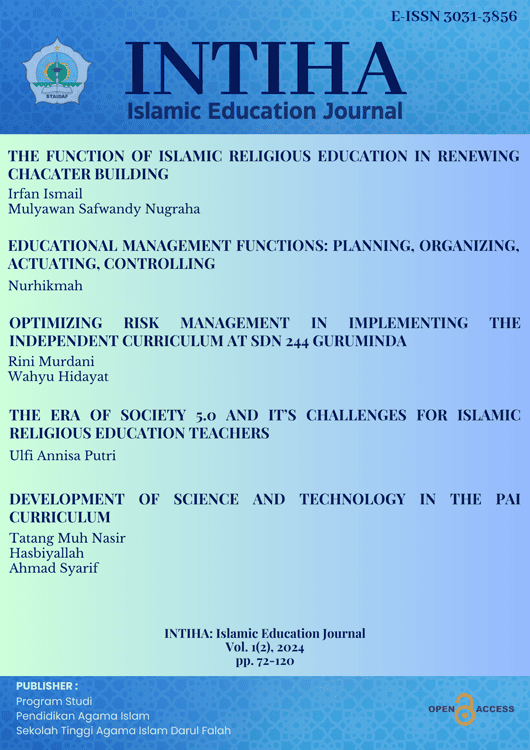
DEVELOPMENT OF SCIENCE AND TECHNOLOGY IN THE PAI CURRICULUM
DOI:
https://doi.org/10.58988/intiha.v1i2.310Keywords:
Science and Technology, Curriculum Development, FiqhAbstract
Education is a conscious effort to prepare students through guidance, teaching and/or training activities, as well as equipping students with knowledge for their future roles. Meanwhile, technology is the application of scientific knowledge and other sciences to solve practical problems. Thus science and technology cannot be separated. Science and technology are developing very rapidly along with the pace of development of society. Science and technology have a reciprocal relationship with education and the curriculum. Education and curriculum must be able to respond to the rapid development of science and technology, because education is an effort to prepare students to face a better future. Curriculum development for all subjects including Fiqh must be based on developments in science and technology. The development of science and technology directly has implications for curriculum development which includes objectives, materials, methods and evaluation. Technology has an important role in developing the Fiqh curriculum because Fiqh material must always be up to date with the conditions and needs of students. Fiqh learning must always be contextual to students' real lives so that its existence is always present and becomes a student's need.
References
Agustian, N., & Salsabila, U. H. (2021). Peran Teknologi Pendidikan dalam Pembelajaran. Islamika, 3(1), 123–133. https://doi.org/10.36088/islamika.v3i1.1047
Atmowidjoyo, S. … Nahuda, N. (2022). The Development of Multicultural Based Islamic Education Curriculum in General Higher Education. Ilomata International Journal of Social Science, 3(2), 207–215.
Daud, R. M. (2023). Theory Of Islamic Education, Philosophy And Curriculum At Tertiary Level. Educator Development Journal, 1(2), 106–126. https://doi.org/https://doi.org/10.2022/edj.v1i2.4006
Faisal, & Martin, S. N. (2019). Science education in Indonesia: Past, present, and future. Asia-Pacific Science Education, 5(1), 1–29. https://doi.org/10.1186/s41029-019-0032-0
Khumairoh, A. (2022). The Importance of Inculcating Character Education in Facing the Era of Globalization in the 21st Century Generation. Jurnal Pendidikan Karakter, 13(1), 27–37. https://doi.org/10.21831/jpka.v13i1.41787
Liam, L. … Carsten, L. (2023). Utilization of ICT in Learning the History of Islamic Culture. Scientechno: Journal of Science and Technology, 2(1), 64–79. https://doi.org/10.55849/scientechno.v2i1.49
Lingga, S. A. F. … Kurniawan, P. (2023). History of the Development of Philosophy and Science in the Islamic Age. Solo International Collaboration and Publication of Social Sciences and Humanities, 1(01), 1–11. https://doi.org/https://doi.org/10.61455/sicopus.v1i01.5
Malik, R. S. (2018). Educational Challenges in 21St Century and Sustainable Development. Journal of Sustainable Development Education and Research, 2(1), 9. https://doi.org/10.17509/jsder.v2i1.12266
Marlina, R. … Sandra, N. M. (2021). Application of Crossword Puzzle Multimedia to Improve the Science Education Learning Process and Outcomes at Junior High Schools. JPI (Jurnal Pendidikan Indonesia), 10(4), 622–632. https://doi.org/https://doi.org/10.23887/jpi-undiksha.v10i4.25350
Moleong. (2019). Metodologi Penelitian Kualitatif (Edisi Revisi). PT. Remaja Rosda Karya.
Mutaqin, M. Z. … Rahmawati, S. (2024). Factors in Religious Culture to Increase Tolerant Attitude of Gen-Z Among Urban Muslims. Akademika: Jurnal Pemikiran Islam, 29(1), 73–86. https://doi.org/https://doi.org/10.32332/akademika.v29i1.9145
Nasution, H. B. … Saputra, I. B. (2022). The distribution of science according to Muslim philosophers. Ta Dib Jurnal Pendidikan Islam, 11(1), 53–64. https://doi.org/https://doi.org/10.29313/tjpi.v11i1.9045
Nawawi, H. (2020). Penelitian Terapan. Gajah Mada University Press.
Norman, N. A. (2021). Ibn Sina’s Theory of the Soul: A Taxonomy of Islamic Education. ICR Journal, 12(2), 275–289. https://doi.org/https://doi.org/10.52282/icr.v12i2.867
Nugroho, A. P. … Anne, Z. S. (2024). Renewable energy education and awareness among Indonesian students: Exploring challenges and opportunities for a sustainable future. Sustainable Energy Technologies and Assessments, 63, 103631. https://doi.org/https://doi.org/10.1016/j.seta.2024.103631
Pangesti, K. I. … Sugianto, S. (2017). Bahan ajar berbasis STEM (Science, Technology, Engineering, and Mathematics) untuk meningkatkan penguasaan konsep siswa SMA. UPEJ Unnes Physics Education Journal, 6(3), 53–58.
Pattier, D. (2021). Science on Youtube: successful edutubers. Techno Review. International Technology, Science and Society Review/Revista Internacional de Tecnología, Ciencia y Sociedad, 10(1), 1–15. https://doi.org/https://doi.org/10.37467/gka-revtechno.v10.2696
Puspitarini, Y. D., & Hanif, M. (2019). Using Learning Media to Increase Learning Motivation in Elementary School. Anatolian Journal of Education, 4(2), 53–60. https://doi.org/10.29333/aje.2019.426a
Saridudin. (2022). Landasan Ilmu Pengetahuan Dan Teknologi Dalam Pengembangan Kurikulum. Puslitbang Pendidikan Agama Dan Keagamaan, 1–12.
Saridudin, S. (2020). Pengembangan Kurikulum Pendidikan Diniyah Formal (Pdf) Di Pesantren Ulya Zainul Hasan Probolinggo. EDUKASI: Jurnal Penelitian Pendidikan Agama Dan Keagamaan, 18(1), 84–99. https://doi.org/10.32729/edukasi.v18i1.690
Susanty, A. … Vernanda, D. (2023). Metode Penelitian Kualitatif. CV. Future Science.
Suparman, A, T. (2020). Kurikulum dan Pembelajaran, Grobongan. Prenada Media Grup.
Utama, K. W. (2012). Manfaat lisensi paten bagi industri teknologi dan informasi Indonesia. Masalah-Masalah Hukum, 41(3), 385–391.
Warner, S., & Myers, K. (2010). The Creative Classroom: The Role of Space and Place toward Facilitating Creativity. Technology Teacher, 69.
Downloads
Published
How to Cite
Issue
Section
License
Copyright (c) 2024 Tatang Muh Nasir, Hasbiyallah Hasbiyallah, Ahmad Syarif

This work is licensed under a Creative Commons Attribution-ShareAlike 4.0 International License.