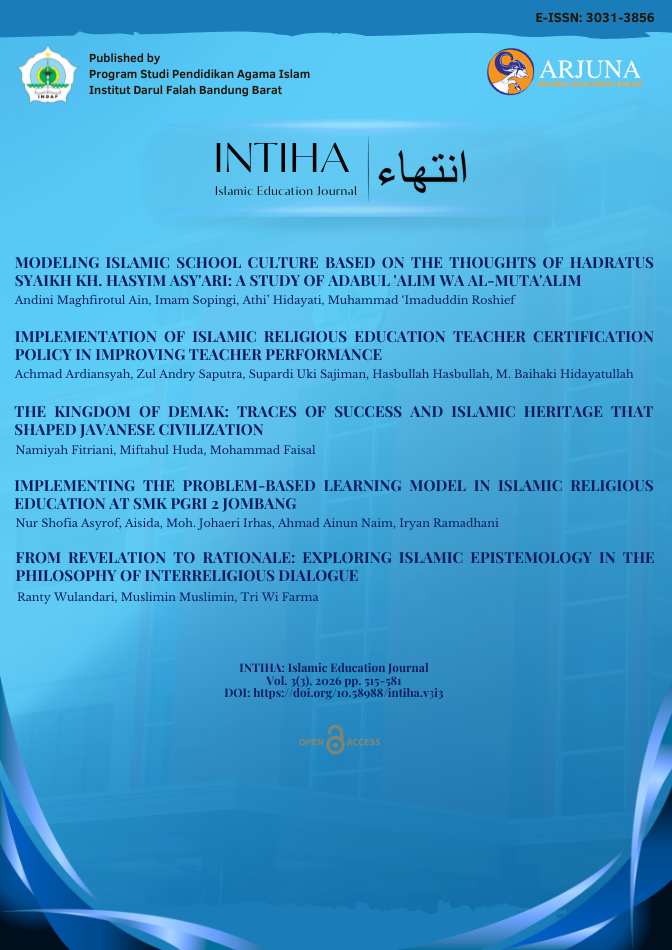
MODELING ISLAMIC SCHOOL CULTURE BASED ON THE THOUGHTS OF HADRATUS SYAIKH KH. HASYIM ASY'ARI: A STUDY OF ADABUL 'ALIM WA AL-MUTA'ALIM
DOI:
https://doi.org/10.58988/intiha.v3i3.485Keywords:
Adabul 'Alim wa Al-Muta'alim, Character Education, KH. Hasyim Asy'Ari, School CultureAbstract
The moral crisis within the educational environment highlights the urgency of strengthening character based on Islamic values. Adabul 'Alim wa Al-Muta'alim, a book by KH. Hasyim Asy'ari, outlines principles of proper conduct in the teaching and learning process that contribute to shaping an Islamic school culture. This study seeks to explore ethical and character values that influence school culture through the lens of KH. Hasyim Asy'ari’s educational philosophy. Employing a qualitative approach, this research utilizes a literature review method with content analysis of the primary text and other relevant supporting sources. The focus centers on students’ manners toward themselves, their teachers, and their studies, alongside the role of educators in instilling Islamic ethics throughout the educational process. The findings reveal that KH. Hasyim Asy'ari emphasizes cultivating positive habits through the consistent practice of religious activities such as congregational prayer, tadarus (Qur’anic recitation), the use of respectful language, and the development of institutional structures that model exemplary behavior. These practices foster interaction patterns and routines that nurture a religious atmosphere and strong moral character within schools. The application of these principles offers a valuable contribution to the development of Islamic school culture and provides relevant solutions to the challenges of contemporary character education.
References
Abdussamad, J., Sopingi, I., Setiawan, B., & Sibua, N. (2024). Metode Penelitian: Kuantitatif, Kualitatif, dan Mixed Methode. PT Media Penerbit Indonesia.
Ahmad. (2021). Konsep Ta’dib Syed Muhammad Naquib Al-Attas dan Implikasinya dalam Pendidikan Islam. AN NUR: Jurnal Studi Islam, 13(1), 32–50. https://doi.org/10.37252/an-nur.v13i1.98
Aini, Q. (2023). Implementation of KH. Hasyim Asy’ari’s Educational Thought. Al-Fadlan: Journal of Islamic Education and Teaching, 1(2), 73–80. https://doi.org/10.61166/fadlan.v1i2.34
Al-Attas, S. M. N. (1989). Islam and the Philosopy of Science. ISTAC.
Al-Attas, S. M. N. (1993). Islam and Secularism. International Institute of Islamic Thought and Civilization (ISTAC).
Al-Attas, S. M. N. (1995). Prolegomena To the Metaphysics of Islam-Syed-Muhammad-Naquib-Al-Attas. International Institute of Islamic Thought and Civilization (ISTAC).
Amalia, A., Sopingi, I., Hidayati, A., & Yumna, H. (2025). Transformation of Education According to Hadratussyaikh Hasyim Asy’ari An Examination of the Book of Adabul ’Alim wal Muta’alim. LECTURES: Journal of Islamic and Education Studies, 4(2), 194–204. https://doi.org/10.58355/lectures.v4i2.147
Amaly, A. M., Herdiana, Y., Ruswandi, U., & Arifin, B. S. (2023). The necessity and reality of Islamic religious education in schools. Jurnal Ilmiah Islam Futura, 23(1), 1–19. https://doi.org/10.22373/jiif.v23i1.13190
Anggadwita, G., Dana, L.-P., Ramadani, V., & Ramadan, R. Y. (2021). Empowering Islamic boarding schools by applying the humane entrepreneurship approach: the case of Indonesia. International Journal of Entrepreneurial Behavior & Research, 27(6), 1580–1604. https://doi.org/10.1108/IJEBR-11-2020-0797
Ansar, Irmawanty, & Rukman, Y. W. (2020). Pengaruh budaya sekolah terhadap pembentukan karakter siswa. KROMATIN: Jurnal Biologi Dan Pendidikan Biologi, 1(1), 2020. https://doi.org/10.17977/um084v3i22025p480-487
Asy’ari, K. M. H. (2020). Adab al-’Alim wa al-Muta’allim dalam Mahakarya Hadratus Syaikh KH. M. Hasyim Asy’ari. Pustaka Tebuireng.
Asy’ari, K. M. H. (2022). Adab al-Alim Wa al-Muta’allim. Pustaka Tebuireng.
Aulia, F., Yusuf, A., Hanifa, W. N., & Arianti, I. C. (2024). Relevansi Pemikiran KH . Hasyim Asy’ari Tentang Pendidikan Karakter di Era Modern. Bhinneka: Jurnal Bintang Pendidikan Dan Bahasa, 2(1), 75–90. https://doi.org/10.59024/bhinneka.v2i1.636
Azwar, & Usman, A. H. (2025). Mengembalikan Kesejatian Peran Orang Tua dalam Pendidikan Anak: Sebuah Tinjauan Konseptual. TARBIYAH: Jurnal Pendidikan Dan Pembelajaran, 2(1), 31–54.
Brilian, K. A., Sopingi, I., & Hidayati, A. (2025). The Concept of Syafaat (Intercession) in Education: A Study of the Book Nurul Mubin. Pelita: Jurnal Studi Islam Mahasiswa UII Dalwa, 2(2), 173–184. https://doi.org/10.38073/pelita.v2i2.2688
Deal, T. E., & Peterson, K. D. (2009). Shaping School Culture: Pitfalls, Paradoxes, and Promises. Jossey-Bass.
Elysa, H. R. D. S. S. D. N. F. N. R. N. (2025). Introducing Hajj Values to Early Childhood Through Experiential Learning at the Sudiang Ka ’ bah Replica. Jurnal Al Burhan, 5(1), 143–154.
Febrianti, D., Sopingi, I., & Musfiroh, A. (2025). Peran Ulama Dalam Proses Kodifikasi Al-Qur’an dan Hadist: Sebuah Pendekatan Library Research. At-Tahbir: Jurnal Studi Al-Qur’an Dan Tafsir, 1(2), 83–104.
Fitria, F., & Suharyat, Y. (2022). Internalisasi nilai dan karakter melalui budaya sekolah dengan kegiatan Jumat Bersih di SMAN 8 Bekasi. Cakrawala: Jurnal Pengabdian Masyarakat Global, 1(4), 9–19. https://doi.org/10.30640/cakrawala.v1i4.335
Gulya, N. M., & Fehérvári, A. (2024). Multiculturalism in the curriculum: a comparative analysis of the Finnish, Irish and Hungarian national core curricula. Journal for Multicultural Education, 18(4), 359–371. https://doi.org/10.1108/JME-10-2023-0113
Hägg, G., & Jones, C. (2021). Educating towards the prudent entrepreneurial self – an educational journey including agency and social awareness to handle the unknown. International Journal of Entrepreneurial Behavior & Research, 27(9), 82–103. https://doi.org/10.1108/IJEBR-10-2020-0668
Haq, D. Z., & Amin, A. (2023). Pengaruh Budaya Sekolah terhadap Kedisiplinan Siswa dalam Melaksanakan Tata Tertib di Sekolah. GEOGRAPHIA: Jurnal Ilmiah Pendidikan Geografi, 3(2), 1–8. https://doi.org/10.33558/geographia.v3i2.8289
Harnilawati, Insiyanda, D. R., Sopingi, I., Indriasari, E., Nubatonis, O. E., Schouten, F. S., Suryandari, M., Udil, P. A., Veronica, & Wangge, M. (2024). Metodologi Penelitian. Cendekia Publisher.
Hartanto, A. (2024). Konsep Pendidikan Karakter dalam Perspektif Pemikiran Syeikh KH Hasyim Asy’ari Berdasarkan Surat Al-An’am Ayat 151-153. Innovative: Journal Of Social Science Research, 4(6), 3674–3691. https://doi.org/10.31004/innovative.v4i6.16390
Istiqomah, Dewi, S. E. K., & Kholidin, N. (2022). Pengaruh Budaya Sekolah terhadap Karakter Peserta Didik di Sekolah Dasar. FingeR: Journal of Elementary School, 1(1), 11–19. https://doi.org/10.30599/finger.v1i1.94
Laily, D. F. D. N., Sopingi, I., & Hidayati, A. (2025). Tawasul dalam Pendidikan Islam Perspektif Hadrotus Syaikh KH Muhammad Hasyim Asy’ari: Telaah Kitab Nurul Mubin. Revorma: Jurnal Pendidikan Dan Pemikiran, 5(1), 128–138. https://doi.org/10.62825/revorma.v5i1.136
Mainuddin, Tobroni, & Nurhakim, M. (2023). Pemikiran Pendidikan Karakter Al-Ghazali, Lawrence Kolberg dan Thomas Lickona. Attadrib: Jurnal Pendidikan Guru Madrasah Ibtidaiyah, 6(2), 283–290. https://doi.org/10.54069/attadrib.v6i2.563
Manalu, H., Ramly, F., & Sopingi, I. (2024). Metode Penelitian Ekonomi: Konsep, Metode, dan Implementasi. PT. Mifandi Mandiri Digital.
Moslimany, R., Otaibi, A., & Shaikh, F. (2024). Designing a holistic curriculum: Challenges and opportunities in islamic education. Journal on Islamic Studies, 1(1), 52–73. https://doi.org/10.35335/beztg009
Nurdiana, L., & Mutamakin. (2023). Implementation of KH. Hasyim Asy’ari’s Educational Thinking on Today’s Education. RABBAYANI: Jurnal Pendidikan Dan Peradaban Islami, 3(1), 2023.
Rohmah, S. M., Sopingi, I., & Musfiroh, A. (2025). Pembelajaran Moral dari Amsal Al-Qur’an: Sebuah Analisa Kritis. AT-TAHBIR: Jurnal Studi Al-Qur’an Dan Tafsir, 2(1), 47–62.
Rosidin, & Andriani, F. (2022). Literature Analysis of Tafsīr Tarbawiy (Qur’anic Educational Interpretation) from Paul Ricoeur’s Hermeneutic Perspective and Its Relevance as A Source of Islamic Education. SUHUF, 15(1), 175–196. https://doi.org/10.22548/shf.v15i1.705
Schein, E. H. (2010). Organizational Culture and Leadership. Jossey-Bass.
Septiana, R. A., Sopingi, I., & Hidayati, A. (2025). Adab Penggunaan Artificial Intelligence (AI) dalam Keilmuan: Tinjauan Kitab Adabul Alim Wal Muta’allim. Jurnal Revorma, 5(1), 71–82. https://doi.org/10.62825/revorma.v5i1.134
Setiawati, V. S. R., Sopingi, I., & Hidayati, A. (2025). Rahasia Belajar Ilmu Barokah: Kunci Menuju Kesuksesan di Dunia Pendidikan Menurut Hadratus Syaikh KH Hasyim Asy’ari. Pelita: Jurnal Studi Islam Mahasiswa UII Dalwa, 2(2 SE-Articles), 198–214. https://doi.org/10.38073/pelita.v2i2.2690
Sopingi, I. (2016). Etika Bisnis Menurut Al-Ghazali: Telaah Kitab Ihya’ ’Ulum Al-Din. Iqtishoduna, 10(2), 142–148. https://doi.org/10.18860/iq.v10i2.3223
Sopingi, I., Subroto, D. E., Sholihan, Sarwandi, Effendi, Darmawati, Syamsul, E. M., Krogt, H. Van Der, Widiastono, A., Mardhotillah, B., Aminah, S., Rasiwan, I., & Wayahdi, M. R. (2025). Pengantar Filsafat Ilmu: Menyelami Dasar-Dasar Ilmu Pengetahuan. PT. Mifandi Mandiri Digital.
Sunarti, & Suyatman. (2025). Penguatan Budaya Islam dalam Sistem Pendidikan Sekolah Negeri. Dirasah, 8(1), 171–180.
Tamphu, S., Suyitno, I., Susanto, G., Budiana, N., & Salim, M. R. (2024). Building bridges to the future of learning : Exploring artificial intelligence research using R- Studio assisted bibliometrics. Cogent Education, 11(1). https://doi.org/10.1080/2331186X.2024.2417623
Taulabi, I., Adnan, L., & Ubaidila, S. (2024). Etika Guru dalam Pandangan KH. Hasyim Asy’ari: Studi atas Adab al-‘Alim wa al-Muta ‘allim di Era Disrupsi. Realita: Jurnal Penelitian Dan Kebudayaan Islam, 22(2), 190–206. https://doi.org/10.30762/realita.v22i2.299
Wang, X., Wong, Y. D., & Yuen, K. F. (2023). Going solo and feeling smart? An exploratory study on shoppers’ time valuation and cultural perception. Internet Research, 33(4), 1276–1301. https://doi.org/10.1108/INTR-10-2021-0748
Downloads
Published
How to Cite
Issue
Section
License
Copyright (c) 2026 Andini Maghfirotul Ain, Imam Sopingi, Athi’ Hidayati, Muhammad ‘Imaduddin Roshief

This work is licensed under a Creative Commons Attribution-ShareAlike 4.0 International License.