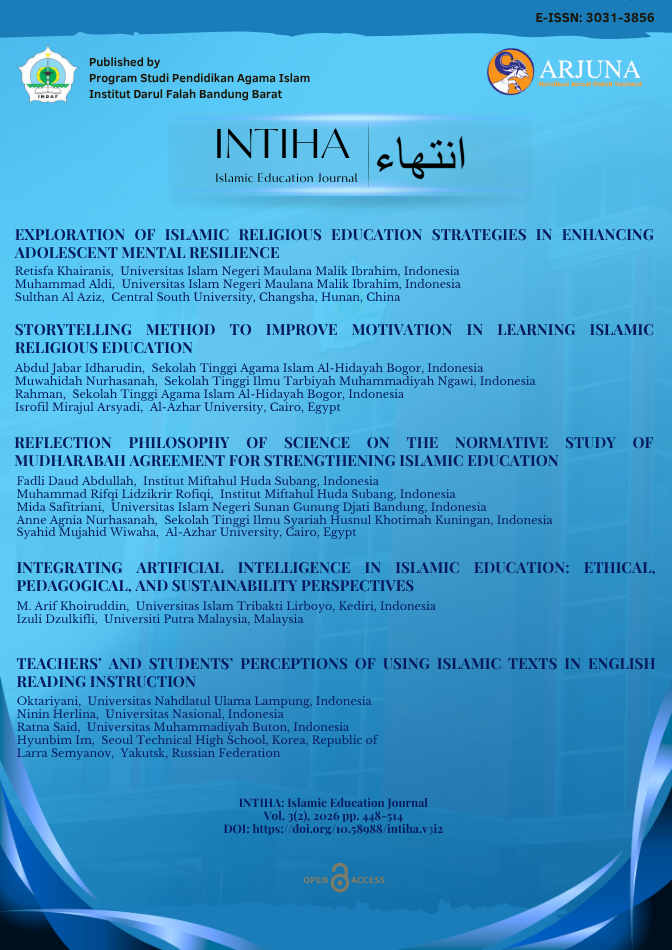
EXPLORATION OF ISLAMIC RELIGIOUS EDUCATION STRATEGIES IN ENHANCING ADOLESCENT MENTAL RESILIENCE
DOI:
https://doi.org/10.58988/intiha.v3i2.442Keywords:
Exploration, Islamic Religious Education, Mental Resilience, StrategiesAbstract
Muslim adolescents frequently face various pressures and challenges that affect their mental health. Islamic religious education can improve adolescents' mental resilience by teaching religious values and spiritual practices. This research aims to explore effective Islamic religious education strategies for enhancing adolescents' mental resilience. This research uses qualitative methods with in-depth interviews and document analysis to collect data from teachers and students involved in the Islamic religious education program. The results showed that Islamic religious education strategies, such as teaching faith values, spiritual practices such as prayer and dhikr, and social support from the community, can help improve adolescents' mental resilience. These strategies help adolescents develop stress-coping skills and maintain mental balance. This research concludes that Islamic religious education can improve adolescents' mental resilience through comprehensive and religious values-based strategies. Thus, this study contributes to developing educational programs that are more effective in supporting adolescents' mental well-being.
References
Aldi, M., & Kawakib, A. N. (2025). Reconstruction of Islamic Education Philosophy in Minangkabau Customary Values: Actualizing the Principles of Adat Basandi Syarak, Syarak Basandi Kitabullah. JIIP-Jurnal Ilmiah Ilmu Pendidikan, 8(2), 1548–1557.
Aldi, M., & Khairanis, R. (2024). The Synergy of Religion and Malay Culture in Improving the Empowerment of Islamic Communities Towards Achieving SDGS. PERADA, 7(2).
Bhakuni, M. S., Das, U., Bhakuni, P., Ramesh Kumar, S., & Das, A. (2025). An Integrated MCDM-Based Mathematical Modeling Approach for Sustainable Practices of Vermicomposting in Educational Institutions. Process Integration and Optimization for Sustainability, 1–18.
Charis, V., Zafeiroudi, A., Trigonis, I., Tsartsapakis, I., & Kouthouris, C. (2025). The Impact of Green Spaces on Workplace Creativity: A Systematic Review of Nature-Based Activities and Employee Well-Being. Sustainability, 17(2), 390.
Ciptadi, T. (2025). The Challenges and Opportunities of Digitalization in Islamic Religious Education Institutions. IJGIE (International Journal of Graduate of Islamic Education), 6(1), 1–10.
Firdaus, R., Fahlefi, R., Wadi, M., & Kamali, K. (2025). The Role of Islamic Philanthropy in Disaster Relief in Indonesia and Japan. Asian Journal of Muslim Philanthropy and Citizen Engagement, 1(1), 35–51.
Ilhamsyah, R., Nafisa, A. R., & Santi, D. (2025). The Contribution Of Islamic Education In Building Community Morality. Kiswah Jurnal Of Islamic Studies And Education, 1(1), 1–9.
Luo, Y., Li, S., Feng, L., Zheng, J., Peng, C., & Bao, L. (2025). Impact of Psychological Resilience on the Fear of Pain and Activity Recovery in Postsurgical Patients: Observational Cohort Study. JMIR Formative Research, 9, e63556.
Mustofa, M. B., & Wuryan, S. (2025). Interpersonal Communication and Family Resilience Regarding an Adult Relative’s Mental Health Problem in Islamic Law Perspective. RADEN INTAN: Proceedings on Family and Humanity, 2(1), 146–158.
Pei, M. (n.d.). Toward a Lebanese Alphabet, Toward a New Middle East. Language, Memory, and Identity in the Middle East, 215.
Rahmah, S., & Hermina, D. (2025). Types And Application of Qualitative Research Methods In Islamic Religious Education (Pai) Research. As-Sulthan Journal of Education, 1(3), 503–513.
Ribbons, K., Cochrane, J., Johnson, S., Wills, A., Ditton, E., Dewar, D., Broadhead, M., Chan, I., Dixon, M., & Dunkley, C. (2025). Biopsychosocial-based machine learning models predict patient improvement after total knee arthroplasty. Scientific Reports, 15(1), 4926.
Salsabila, D. A., & Rohmah, N. (n.d.). Resilience Factors in Early Childhood: Islamic Values and Self-Regulation through a Mixed-Method Approach. Golden Age: Jurnal Ilmiah Tumbuh Kembang Anak Usia Dini, 9(4), 633–646.
Sukabdi, Z. A., Syauqillah, M., Priyanto, S., & Muzayanah, U. (2025). Health Resilience: A Review. 499–517.
Ugwu, C. N., Ugwu, O. P.-C., Alum, E. U., Eze, V. H. U., Basajja, M., Ugwu, J. N., Ogenyi, F. C., Ejemot-Nwadiaro, R. I., Okon, M. B., & Egba, S. I. (2025). Sustainable development goals (SDGs) and resilient healthcare systems: Addressing medicine and public health challenges in conflict zones. Medicine, 104(7), e41535.
Wang, Z., Wang, F., Cui, Z., Meng, F., Guo, H., Tian, B., & Li, N. (2025). Global Scientific Trends on Anxiety Disorders in the Early Twenty‐First Century: A Data‐Driven Bibliometric Analysis. Depression and Anxiety, 2025(1), 5541514.
Downloads
Published
How to Cite
Issue
Section
License
Copyright (c) 2026 Retisfa Khairanis, Muhammad Aldi, Sulthan Al Aziz

This work is licensed under a Creative Commons Attribution-ShareAlike 4.0 International License.