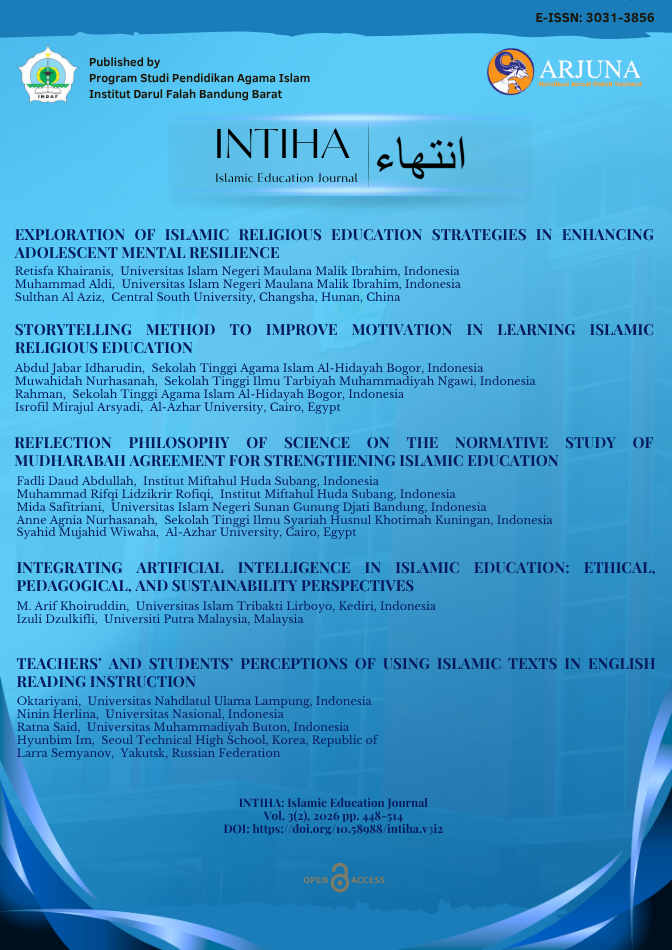
INTEGRATING ARTIFICIAL INTELLIGENCE IN ISLAMIC EDUCATION: ETHICAL, PEDAGOGICAL, AND SUSTAINABILITY PERSPECTIVES
DOI:
https://doi.org/10.58988/intiha.v3i2.458Keywords:
Artificial Intelligence, Ethics in Technology, Islamic EducationAbstract
Integrating Artificial Intelligence (AI) into Islamic education represents a significant advancement in educational innovation, offering new possibilities for enhancing learning experiences, expanding access, and supporting curriculum development. However, its implementation must be approached with caution to ensure alignment with Islamic ethical principles, educational traditions, and cultural diversity. This qualitative, literature-based study systematically analyzes peer-reviewed articles, reports, and books published between 2019 and 2024 to explore the potentials and challenges of AI in Islamic education. The study focuses on three critical aspects: (1) the development of AI technologies that comply with Islamic values and shariah, (2) teacher training for value-conscious and effective AI use, and (3) sustainability strategies for long-term integration. Findings suggest that while AI offers promising solutions for personalization and accessibility, its effectiveness depends on ethical oversight, technological infrastructure, and pedagogical readiness. This study proposes a conceptual framework to guide responsible AI integration in Islamic education, contributing to developing future-ready and values-driven educational models.
References
Alhajj, I. Q. A., Budiman, B., Karolina, A., Apriani, E., Warlizasusi, J., & Kurniawan, K. (2024). Artificial Intelligence: Opportunities and Threats in Islamic Higher Education. Mudir : Jurnal Manajemen Pendidikan, 6(1), Article 1. https://doi.org/10.55352/mudir.v6i1.972
Dina, S. (2023). Superior Islamic Education Reform Through AI Digital Transformation Bridge: Opportunity or Challenge? Imam Bonjol International Conference on Islamic Education (IBICIE), 445–458.
Fikriyah, E., Said, N., Muniron, & Sufirmasnyah. (2024). Enhancement Learning Results Fiqih Study Materials Through Method Discussion on Participant Educate Class VIII F Mts. Manbail Futuh Beji Jenu Tuban. Proceeding International Conference on Education, 955–961.
Hayati, N., & Ushalli, E. (2024). Digital Transformation in Islamic Education: Integrating AI and Machine Learning for Personalized Learning in Madrasah. Journal of Scientech Research and Development, 6(2), Article 2. https://doi.org/10.56670/jsrd.v6i2.528
Karim, A. A. (2024). Integration of AI Tools in Islamic Education Curriculum Development Management: Challenges and Opportunities. Journal of Loomingulisus Ja Innovatsioon, 1(3), Article 3. https://doi.org/10.70177/innovatsioon.v1i3.1298
Karimullah, S. S. (2023). The Application of Artificial Intelligence in Islamic Law Discovery. Mutawasith: Jurnal Hukum Islam, 6(2), 109–121. https://doi.org/10.47971/mjhi.v6i2.748
Khoirunisa, A., Rohman, F., Azizah, H. A., Ardianti, D., Maghfiroh, A. L., & Noor, A. M. (2023). Islam amid AI (Artificial Intelligence) Struggles: Between Opportunities and Threats. SUHUF, 35(1), Article 1. https://doi.org/10.23917/suhuf.v35i1.22365
Mansir, F. (2022). Problems of Islamic Religious Education in the Digital Era. At-Ta’dib, 17(2), Article 2. https://doi.org/10.21111/at-tadib.v17i2.8405
Mudrik, M., Almujahid, A., & Juniarni, C. (2024). Islam and Artificial Intelligence (AI): Ethical Considerations and the Potential Impact on Islamic Societies. Islamic Studies Journal (ISLAM), 1(3), Article 3. https://doi.org/10.62207/6vzpya86
Mukarom, Z., Heriyanto, I., Hermansyah, Y., Baehaqi, A., Yudiyanto, M., & Setiawan, B. (2023). Integration of AI in Islamic Education: Ethical Opportunities and Challenges. International Conference on Health Science, Green Economics, Educational Review and Technology, 5(2), Article 2. https://doi.org/10.54443/ihert.v5i2.411
Page, M. J., McKenzie, J. E., Bossuyt, P. M., Boutron, I., Hoffmann, T. C., Mulrow, C. D., Shamseer, L., Tetzlaff, J. M., Akl, E. A., Brennan, S. E., Chou, R., Glanville, J., Grimshaw, J. M., Hróbjartsson, A., Lalu, M. M., Li, T., Loder, E. W., Mayo-Wilson, E., McDonald, S., … Moher, D. (2021). The PRISMA 2020 statement: An updated guideline for reporting systematic reviews. https://doi.org/10.1136/bmj.n71
Shemshack, A., Kinshuk, & Spector, J. M. (2021). A comprehensive analysis of personalized learning components. Journal of Computers in Education, 8(4), 485–503. https://doi.org/10.1007/s40692-021-00188-7
Snyder, H. (2019). Literature review as a research methodology: An overview and guidelines. Journal of Business Research, 104, 333–339. https://doi.org/10.1016/j.jbusres.2019.07.039
Supa’at, & Muslim, M. (2023). Character Education Model in Islamic Boarding School-Based Madrasa (The Implementation Of Salih-akram Character Education At Matholiul Falah Islamic Boarding School Pati – Central Java – Indonesia). International Journal of Education Humanities and Social Science, 06(03), 182–199. https://doi.org/10.54922/IJEHSS.2023.0529
Suwartini, S. (2022). Artificial Intelligence In Global Islamic Education. IOSR Journal Of Humanities And Social Science (IOSR-JHSS), 27, 39–49. https://www.semanticscholar.org/paper/Artificial-Intelligence-In-Global-Islamic-Education-Suwartini/828e259ffcfa2d15b91a66fa4d99f9a872916500
Syarif, S., Abdullah, F., & Herlambang, S. (2024). Multiculturalism among Students in Madrasah: Knowledge, Challenges, and Social Capital. Nazhruna: Jurnal Pendidikan Islam, 7(2), Article 2. https://doi.org/10.31538/nzh.v7i2.4710
Downloads
Published
How to Cite
Issue
Section
License
Copyright (c) 2026 M. Arif Khoiruddin, Izuli Dzulkifli

This work is licensed under a Creative Commons Attribution-ShareAlike 4.0 International License.