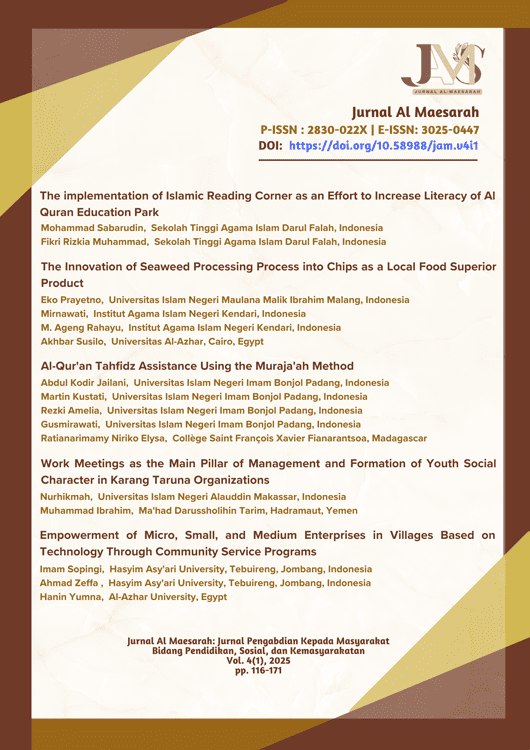
Work Meetings as the Main Pillar of Management and Formation of Youth Social Character in Karang Taruna Organizations
DOI:
https://doi.org/10.58988/jam.v4i1.402Keywords:
Social Character, Work Meeting, Youth OrganizationAbstract
This research examines how work meetings serve as the primary foundation for managing and developing social character within Karang Tarun Boto Lempangang's youth groups. The effectiveness of work meetings in enhancing coordination, communication, and decision-making inside the youth organization is the primary issue raised. Due to few studies that specifically reviewed the role of work meetings in influencing the management of social organizations such as Karang Taruna, this research was conducted. The main respondents were members and administrators of Karang Taruna who actively participated in work meetings. Data analysis was carried out using thematic analysis techniques to identify the main themes related to the role of work meetings. According to the study's findings, productive meetings can speed up decision-making, enhance internal communication, and enhance member coordination. Work meetings also contribute to members' empowerment and increase sense of community inside the company. The study's conclusion is that in order to properly accomplish organizational objectives, Karang Taruna management must improve the quality of work meetings.
References
Atatsi, E. A., Azila-Gbettor, E. M., & Mensah, C. (2021). Predicting task performance from psychological ownership and innovative work behaviour: A cross sectional study. Cogent Business and Management, 8(1). https://doi.org/10.1080/23311975.2021.1917483
Candra, Y., Rahmat, R., & Putra, S. E. (2021). Komunikasi Dan Manajemen Organisasi. Community Engagement and Emergence Journal (CEEJ), 2(3), 44–51. https://doi.org/10.37385/ceej.v2i3.290
Li, T., Helian, Z., & Jin, X. (2024). The organizational mechanism of new technology implementation: an empirical study in the Chinese construction industry. Journal of Asian Architecture and Building Engineering, 00(00), 1–12. https://doi.org/10.1080/13467581.2024.2378006
Liu, G., & An, R. (2021). Applying a yin–yang perspective to the theory of paradox: A review of chinese management. Psychology Research and Behavior Management, 14, 1591–1601. https://doi.org/10.2147/PRBM.S330489
M. Burhanuddin Ubaidillah, A. N. L. S. (2021). Teori Maqosid Syar’iyah Perspektif Ulama Moder dan Kontemporer. Jas Merah, 1, 1–15.
Mangus, S. M. (2023). Personal selling and sales management abstracts. Journal of Personal Selling and Sales Management, 43(4), 368–385. https://doi.org/10.1080/08853134.2023.2268294
McAuliffe, E., Manafa, O., Maseko, F., Bowie, C., & White, E. (2009). Understanding job satisfaction amongst mid-level cadres in Malawi: the contribution of organisational justice. Reproductive Health Matters, 17(33), 80–90. https://doi.org/10.1016/S0968-8080(09)33443-6
Nurhikmah, Indo Santalia, S. (2023). Membangun Kefahaman: Landasan Epistemlogi Kefilsafatan dalam Islam. Setyaki: Jurnal Studi Keagamaan Islam, 1, 87–96. https://doi.org/https://doi.org/10.59966/setyaki.v1i4.736
Nurhikmah, Nursalam, Eko Prayetno, H. Y. (2024). Rural Community Development Through Community Service Program ( KKN ) in Malaka Hamlet , South Sulawesi Selatan. Jurnal Al Maesarah: Jurnal Pengabdian Kepada Masyarakat Bidang Pendidikan, Sosial, Dan Kemasyarakatan, 3(1), 28–40. https://doi.org/https://doi.org/10.58988/jam.v3i1.372
Nurhikmah. (2021). Educational Management Functions: Planning, Organizing, Actuating, Controlling. INTIHA: Islamic Education Journal, 1(2). https://jurnal.staidaf.ac.id/index.php/intiha/article/view/293
Nurhikmah. (2024). Sinergi Karang Taruna Boto Lempangang dan Mahasiswa KKN UINAM dalam Gelar Lomba Semarak Kemerdekaan 17 Agustus Synergy Between Karang Taruna Boto Lempangang and UINAM KKN Students in Holding the Celebration of Independence Day on August 17th. Abdurrauf Journal of Community Service, 1(1), 28–41. https://journal.abdurraufinstitute.org/index.php/arsos 28
Republik Indonesia. (2012). Peraturan Menteri Sosial Republik Indonesia Nomor 77/HUK/2010 Tentang Pedoman Dasar Karang Taruna, Bab I, Pasal 1. Bphn, 2008, 1–4. http://www.bphn.go.id/data/documents/14pmsos008.pdf
Saneba, H., Katuuk, D. A., Rotty, V. N. J., & Lengkong, J. S. J. (2021). Manajemen Organisasi Karang Taruna. Jurnal Bahana Manajemen Pendidikan, 10(1), 138. https://doi.org/10.24036/jbmp.v10i1.112283
Setiawan, R., Anwar, & Burhanudin. (2019). Peran Karang Taruna Dalam Meningkatkan Aktivitas Kepemudaan Di Kelurahan Gunung Lingai Kecamatan Sungai Pinang Kota Samarinda. Jurnal Ilmu Pemerintahan, 7(7), 661–674.
Simanungkalit, P. N. B., Rambe, N. A., Milala, K. N. B., & Wulandari, D. H. (2023). Asesmen Kompetensi Minimum Sebagai Alternatif Peningkatan Kemampuan Literasi Baca Tulis Siswa Sekolah Dasar. Jurnal Inspirasi Pendidikan (ALFIHRIS), 1(2), 262–269.
Tamphu, S., Suyitno, I., Susanto, G., Budiana, N., & Salim, M. R. (2024). Building bridges to the future of learning : Exploring artificial intelligence research using R- Studio assisted bibliometrics. Cogent Education, 11(1). https://doi.org/10.1080/2331186X.2024.2417623
Downloads
Published
How to Cite
Issue
Section
License
Copyright (c) 2025 Nurhikmah, Muhammad Ibrahim

This work is licensed under a Creative Commons Attribution-ShareAlike 4.0 International License.