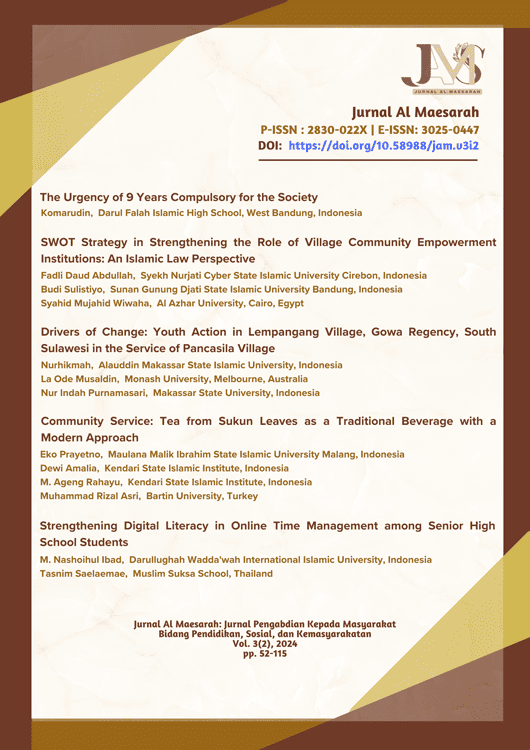
Drivers of Change: Youth Action in Lempangang Village, Gowa Regency, South Sulawesi in the Service of Pancasila Village
DOI:
https://doi.org/10.58988/jam.v3i2.380Keywords:
Pancasila Village, Unity, YouthAbstract
The purpose of this article is a form of dedication to the Pancasila village in Boto Lempangang to strengthen the sense of unity among the community but also to make a real contribution to improving the quality of life of the village residents. Activities such as social service, education, skills training, and environmental initiatives are a means of implementing Pancasila values in everyday life. Their work has become an inspiration for other villages to work together to maintain and develop the values that are the identity of the Indonesian nation. This research uses qualitative research using a case study design. Data collection techniques include interviews, observations, and documentation. Data analysis techniques include data reduction, presentation, conclusion drawing, and verification stages. The research results show that the initiative carried out by the youth of Lempangang Village in the Kampung Pancasila program has had a significant positive impact on the local community. Through various programs such as agricultural counseling, national education and healthy living, developing MSMEs, and increasing food security, village youth have succeeded in strengthening local capacity and creating sustainable change. These programs not only improve economic welfare and public health but also strengthen national values and social solidarity.
References
Alputila, M. J., Tajuddin, M. A., Hukum, F., & Musamus, U. (2024). Peningkatan Kualitas Produk Hukum di Kampung Wasur Melalui Pelatihan dan Pendampingan Penyusunan Produk Hukum Yang Responsif Melibatkan Gerpamat (Gerakan Partisipasi Masyarakat Adat). Cakrawala: Jurnal Pengabdian Masyarakat Global, 3(2), 117–126. https://doi.org/https://doi.org/10.30640/cakrawala.v3i2. 2480 Peningkatan
Alvira, S., Furnamasari, Y. F., & Dewi, D. A. (2021). Pentingnya Pendidikan Kewarganegaraan bagi Generasi Muda sebagai Agent of Change. Jurnal Pendidikan Tambusai, 5(3), 9201–9207.
Anggraeni, F. (2013). Pengembangan Usaha Mikro, Kecil Dan Menengah (UMKM) Melalui Fasilitasi Pihak Eksternal Dan Potensi Internal (Studi Kasus Pada Kelompok Usaha “Emping Jagung” Di Kelurahan Pandanwangi Kecamatan Blimbing Kota Malang). Jurnal Administrasi Publik Mahasiswa Universitas Brawijaya, 1(6), 1286–1295.
Bourchier, D. M. (2019). Two Decades of Ideological Contestation in Indonesia: From Democratic Cosmopolitanism to Religious Nationalism. Journal of Contemporary Asia, 49(5), 713–733. https://doi.org/10.1080/00472336.2019.1590620
Chandra, F. (2021). Peran Pemuda Sebagai Agen of Change Lingkungan Hidup Dalam Rangka Mewujudkan Pembangunan Berkelanjutan. Jurnal Hukum STIH YPM, 3(1), 1–11.
Derung, T. N., Resi, H., & X, I. P. (2023). Toleransi dalam bingkai moderasi beragama: Sebuah studi kasus pada kampung moderasi di Malang Selatan. Kurios, 9(1), 52. https://doi.org/10.30995/kur.v9i1.723
Fatimah, S., & Dewi, D. A. (2021). Pengimplementasian Nilai-Nilai Pancasila Dalam Membangun Karakter Jati Diri Anak Bangsa. Antropocene : Jurnal Penelitian Ilmu Humaniora, 1(3), 70–76.
Fatmala, F., Sari, N. K., Yusdita, E. E., & Akuntansi, P. (2024). Revitalisasi Kampung Wisata Soheden (Soco Herbal Garden) Kabupaten Magetan. Jurnal Terapan Abdimas, 9, 157–163.
Isnaini, P. N., & Dewi, D. A. (2021). Upaya Menerapkan Nilai-Nilai Pancasila Di Masa Pandemi Covid-19. Jurnal Kewarganegaraan, 5(2), 322–328. https://doi.org/10.31316/jk.v5i2.1344
Lahaji, & Faisal, A. (2023). “Caliphate no in Indonesia”: Nurcholish Madjid and Yudian Wahyudi critiques toward Islamic State discourse in Indonesian Islam. Cogent Social Sciences, 9(2). https://doi.org/10.1080/23311886.2023.2278207
Leksana, G. (2021). Collaboration in Mass Violence: The Case of the Indonesian Anti-Leftist Mass Killings in 1965–66 in East Java. Journal of Genocide Research, 23(1), 58–80. https://doi.org/10.1080/14623528.2020.1778612
Mistriani, N., Supriyanto, S., & Triana Putra, D. (2023). Manajemen Wisata Edukasi Kampung Pancasila, cerminan masyarakat Indonesia. Pendidikan Tambusai, 7(2), 14437–14446. https://jptam.org/index.php/jptam/article/view/8683
Muhardis, M. (2023). Learning about independence from Kaba Si Buyuang Karuik. Cogent Arts and Humanities, 10(2). https://doi.org/10.1080/23311983.2023.2270785
Nursida, D., Adriyankan, M., & Sa’diyah, S. H. (2023). Literasi Pendidikan Bela Negara Di Kampung Selaawi Desa Cibalung Kecamatan Cijeruk. Pastabiq : Jurnal Pengabdian Kepada Masyarakat, 2(1), 26–31. https://doi.org/10.56223/pastabiq.v2i1.60
Oktarina, M., & Nengsih, N. (2023). Pengaruh Persepsi dan Preferensi Mahasiswa Terhadap Perilaku Investasi di Galeri Investasi Syariah. MABIS: Jurnal Manajemen Bisnis Syariah, 3(2), 10–20. https://doi.org/10.31958/mabis.v3i2.10453
Pattenden, J. (2023). The patriarchy of accumulation: homework, fieldwork and the production-reproduction nexus in rural Indonesia. Canadian Journal of Development Studies, 44(2), 172–190. https://doi.org/10.1080/02255189.2022.2054784
Pinta, D., Hulu, S., & Hulu, S. K. (2024). Penguatan Ideologi Pancasila Melalui Kampung Pancasila Desa Sogae’Adu Kabupaten Nias. Jurnal Review Pendidikan Dan Pengajaran, 7, 3360–3366. http://journal.universitaspahlawan.ac.id/index.php/jrpp
Risdiany, H., & Anggraeni Dewi, D. (2021). Penguatan Karakter Bangsa Sebagai Implementasi Nilai-Nilai Pancasila. Jurnal Pendidikan Indonesia, 2(4), 696–711. https://doi.org/10.36418/japendi.v2i4.140
Rukmana, I. S., Samsuri, S., & Wahidin, D. (2020). Aktualisasi Nilai-Nilai Pancasila Sebagai Contoh Nyata Ketahanan Ideologi (Studi di Kampung Pancasila, Dusun Nogosari, Desa Trirenggo, Kabupaten Bantul, Daerah Istimewa Yogyakarta). Jurnal Ketahanan Nasional, 26(2), 182. https://doi.org/10.22146/jkn.53815
Sujoko, A. (2023). Social scientist’s perspective on the reaction of the Indonesian government to COVID-19 in the first phase. Cogent Social Sciences, 9(2). https://doi.org/10.1080/23311886.2023.2281045
Sukabdi, Z. A., Sila, M. A., Purnama, C. Y., Nuqul, F. L., Wicaksana, S. A., Wibisono, A. A., & Arief, Y. (2023). Islamophobia among Muslims in Indonesia. Cogent Social Sciences, 9(1). https://doi.org/10.1080/23311886.2023.2209367
Tresnani, V. F., & Adhitya, M. D. K. (2023). Optimalisasi Keterlibatan Pemuda Sebagai Generasi Perubahan Dalam Sistem Demokrasi Melalui Pemilihan Umum 2024. YUSTISIA MERDEKA : Jurnal Ilmiah Hukum, 9(2), 44–54. https://doi.org/10.33319/yume.v9i2.238
Wardhani, L. T. A. L., Noho, M. D. H., & Natalis, A. (2022). The adoption of various legal systems in Indonesia: an effort to initiate the prismatic Mixed Legal Systems. Cogent Social Sciences, 8(1). https://doi.org/10.1080/23311886.2022.2104710
Widayati, A., Winanta, A., Widada, H., & Pratiwi, N. H. (2024). Initiating a sustainable community-based agritourism model of herbal garden in a rural area of Indonesia: perspectives from community members. Cogent Social Sciences, 10(1). https://doi.org/10.1080/23311886.2024.2347049
Widiasari, E., Widodo, S., & Ginting, R. (2023). Peran Kampung Pancasila Sebagai Upaya Dalam Meningkatkan Toleransi di RW 03 Kelurahan Siwalan Kecamatan Gayamsari Kota Semarang. Jurnal Kewarganegaraan, 7(2), 2723–2328.
Downloads
Published
How to Cite
Issue
Section
License
Copyright (c) 2024 Nurhikmah, La Ode Musaldin, Nur Indah Purnamasari

This work is licensed under a Creative Commons Attribution-ShareAlike 4.0 International License.